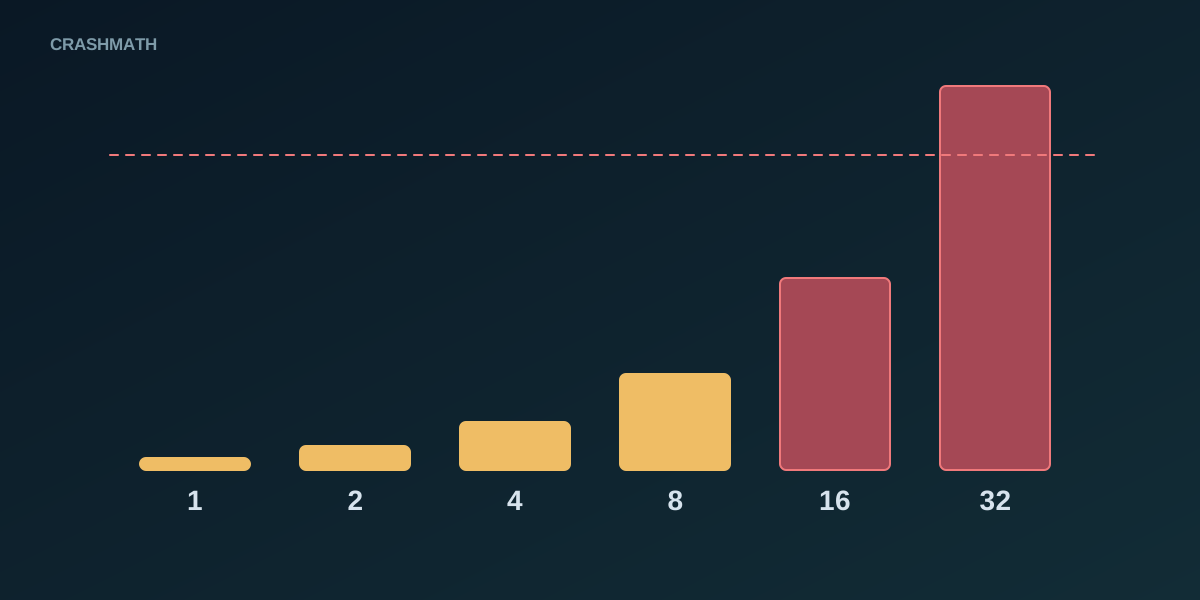


Martingale cannot guarantee recovery because the next requested stake may be unavailable. That is a funding question before the next wager, not permission to spend beyond the bank and then report a negative balance. A blocked progression may leave substantial capital. Distinguishing that residual from literal zero makes the explanation more useful without changing the underlying negative expected return.
We retain the geometric progression and replace unsupported research claims with a bounded, reproducible example. All probabilities below use independent 2x outcomes with win chance 0.485, a declared educational model. No real Lucky Jet packets, accounts or platform limits were measured. The examples do not require a deposit or identify a capital amount that is safe for an individual.
What the doubling sequence actually promises
At a 2x target, a win earns the stake as net profit. Starting with base b, the requested wager on step n after n-1 losses is b×2^(n-1). The previous losses sum to b×(2^(n-1)-1). If the next wager can be accepted and wins, the cycle earns exactly b after subtracting those prior losses. That conditional accounting identity is correct.
To accept step n, the initial cycle capital must cover both previous losses and the next stake: b×(2^n-1), absent fees. This is also the cumulative cost if all n stakes lose. The table uses b=1 and describes arithmetic requirements, not a claim that all steps can be funded by the same 1000-unit bank.
| Step n | Requested stake | Losses before this stake | Initial units required |
|---|---|---|---|
| 1 | 1 | 0 | 1 |
| 2 | 2 | 1 | 3 |
| 3 | 4 | 3 | 7 |
| 4 | 8 | 7 | 15 |
| 5 | 16 | 15 | 31 |
| 6 | 32 | 31 | 63 |
| 7 | 64 | 63 | 127 |
| 8 | 128 | 127 | 255 |
| 9 | 256 | 255 | 511 |
| 10 | 512 | 511 | 1023 |
After nine losses,511 has been spent. A 1000-unit starting bank retains 489. Step ten requests 512, so it cannot be accepted. Ten funded losses would require 1023 initially. If a fully funded tenth wager wins, its gross payment is 1024 and the complete cycle profit is 1. The conditional winning calculation does not supply the missing funding.
A limit can stop the sequence before zero
Consider a separate hypothetical maximum stake 100. The first seven stakes 1 through 64 total 127. The next 128 exceeds that cap, leaving 873 of an initial 1000. Saying that the cap liquidated the whole bank would be false. It blocked the prescribed continuation. The realised 127 loss is still real, and starting a new sequence would add fresh exposure rather than guarantee its recovery.
The model used later has a cap 500. After nine losses, the next 512 exceeds that cap as well as the initial example’s remaining 489. If earlier completed cycles have added profit, there may be enough cash for 512 but the cap still blocks it. None of 100,500 or the integer units is presented as a current limit or currency rule of a named operator. Actual accepted minima, maxima and payout constraints need that version’s rules.
A particular block and a run anywhere
Under the model, the loss chance is q=0.515. A specified block of eight losses has probability q^8≈0.00494832063, or 0.494832%. The chance of at least one run of eight or more somewhere in a larger sequence is different. Overlapping windows cannot be summed as if independent. A long run contributes several overlapping windows without becoming several unrelated observations.
| Loss length | Horizon | Specified block | At least one run |
|---|---|---|---|
| 8 | 200 | 0.494832% | 37.831742% |
| 8 | 500 | 0.494832% | 70.193977% |
| 9 | 500 | 0.254839% | 46.023585% |
| 10 | 500 | 0.131242% | 27.043073% |
In 200 opportunities, at least one 8-loss run has probability about 37.831742%, not near certainty. In 500 it is 70.193977%. A run of ten or more in 500 has probability 27.043073%. These are exact run-model calculations, not a Poisson approximation called a Markov result. The loss-run guide gives the distinction from a preselected block.
These sequence probabilities are not automatically the probability of a bank reaching zero. The progression rule, starting capital, cap and current cycle state determine when continuation stops. In the particular 1000/base 1/cap 500 example, every cycle can fund its first nine loss stakes, but the following 512 is above the cap. Therefore the blocked-continuation event corresponds to the first run of nine losses.
A fully specified finite experiment
The public model generates 5000 synthetic sessions with Python seed 20261023. Each starts at 1000 integer units, base 1, cap 500 and allows at most 500 opportunities. A win at 2x resets the next stake to 1; a loss doubles it. No borrowing, fees, top-ups or stake clipping are allowed. Before accepting any wager the amount must fit both bank and cap.
After settlement, the model checks whether the prescribed next wager is possible, including after the final allowed opportunity. If not, it records a blocked continuation and freezes the residual balance for later milestones. It does not invent another bet or set that balance to zero. All 5000 sessions remain in the cohort’s mean and median, whether active or stopped.
| Opportunities | Blocked /5000 | Exact block probability | Literal zero balances | Mean net, all | Median balance, all |
|---|---|---|---|---|---|
| 50 | 259 | 5.236886% | 0 | -6.8340 | 1023.00 |
| 100 | 547 | 10.981587% | 0 | -13.0588 | 1046.00 |
| 250 | 1288 | 26.209336% | 0 | -29.3196 | 1116.00 |
| 500 | 2301 | 46.023585% | 0 | -54.8760 | 1222.50 |
At 500 opportunities,2301 simulated sessions are blocked and 2699 remain active. None has a literal zero balance under these inputs. The all-cohort mean net is-54.876 units and median final bank 1222.50. Among active sessions alone the median is 1243, which is a different conditional statistic. A favourable survivor median does not contradict a negative mean across everyone.
The exact nine-loss-run probability at 500 is 46.023585%, close to this sample’s 2301/5000. The simulation is finite and its mean net need not equal exactly-3% of its observed mean turnover. Mean turnover is 1851.4424; multiplying it by-0.03 gives-55.543272, a reference rather than an identity for realised random draws. The model’s expected accounting relationship uses expected turnover.
Run the same public code
Download staking_models.py and save it beside the following Python example. It uses the standard library, makes no network calls and places no bets. The four language versions contain identical executable code with the same seed and parameters. Running the downloaded script without options uses this Martingale example too.
# Save staking_models.py beside this example; no casino connection.
import json
import logging
from staking_models import benchmark

result = benchmark(sessions=5000, initial=1000, base=1, cap=500,
                   horizon=500, seed=20261023, strategies=("martingale",))
assert result["pWin"] == 0.485
assert all(row["zeroBalances"] == 0 for row in result["results"])
logging.basicConfig(level=logging.INFO, format="%(message)s")
logging.info(json.dumps(result, indent=2))
Independent acceptance enumerated all paths in 63 short strategy/horizon configurations with rational weights and checked 18664 executed ledger rows. Every wager fit available capital and the cap; balances reconciled to initial plus gross minus stakes. Explicit controls covered the unaccepted 512 wager, a cap-only stop and a properly funded tenth win. The milestone run probabilities also matched a separate exact recurrence.
This is reproducible synthetic evidence, not a report that real gamblers lost their full deposits. It does not describe accounts, deposits, access conditions or product performance. Changing a cap, base, horizon or stopping definition requires a new result. The script also supports other explicitly named rules for separate comparisons, but this article’s cohort uses only Martingale.
Why the expected-return argument survives
Let S be a funded stake chosen from information available before the next independent outcome. At 2x with p=0.485, its conditional expected net is(0.485-0.515)S=-0.03 S. Choosing S after previous losses does not change that conditional law. For this bounded finite experiment, expected session net is-0.03 times expected accepted turnover.
That statement does not mean every session loses 3% of its starting bank, nor that a single realised stopped turnover predicts its realised final amount. It also does not justify applying optional stopping to every unbounded system without integrability conditions. The finite horizon and funded cap make the claim here specific. A sequence of many small winning cycles can coexist with a negative expectation.
Slower or reversed progressions need their own rules
Fibonacci advances along 1,1,2,3,5 after losses and may move back two positions on wins. D’Alembert changes the stake by one unit with a lower floor. Labouchere updates a cancellation list. Their slower or differently shaped escalation does not establish an advantage under the same conditional law. Funding, cap and reset rules remain necessary; no theorem here declares every version identical in drawdown or duration.
For three-win Paroli at 2x, stakes 1,2,4 reset after completion or a loss. A complete cycle gains 7; a loss before completion leaves a net cycle loss 1, not a loss of the entire bank. Under the model, completion probability is 0.485^3=0.114084125 and expected cycle net-0.087327 with expected turnover 2.9109. This illustrates a different distribution without converting paid winnings into free money.
Keep the spending decision separate
The Bankroll Calculator shows unit sizing, specified sequences and optional boundaries. It does not certify a progression or compute this whole cohort. Under negative expectation, constrained Kelly selects zero; a positive recreational fraction is a spending choice. Rounding, a real minimum stake and simultaneous bets can defeat the idea that a fraction always avoids funding failure.
There is no instruction to increase a deposit from 1000 to 1023 merely because that amount funds a hypothetical tenth step. Keep the affordable entertainment limit, and stop rather than fund an escalating recovery promise. Partner actions remain direct registration choices with no compulsory demo stage. They do not verify limits or make a blocked sequence a guaranteed future profit.