
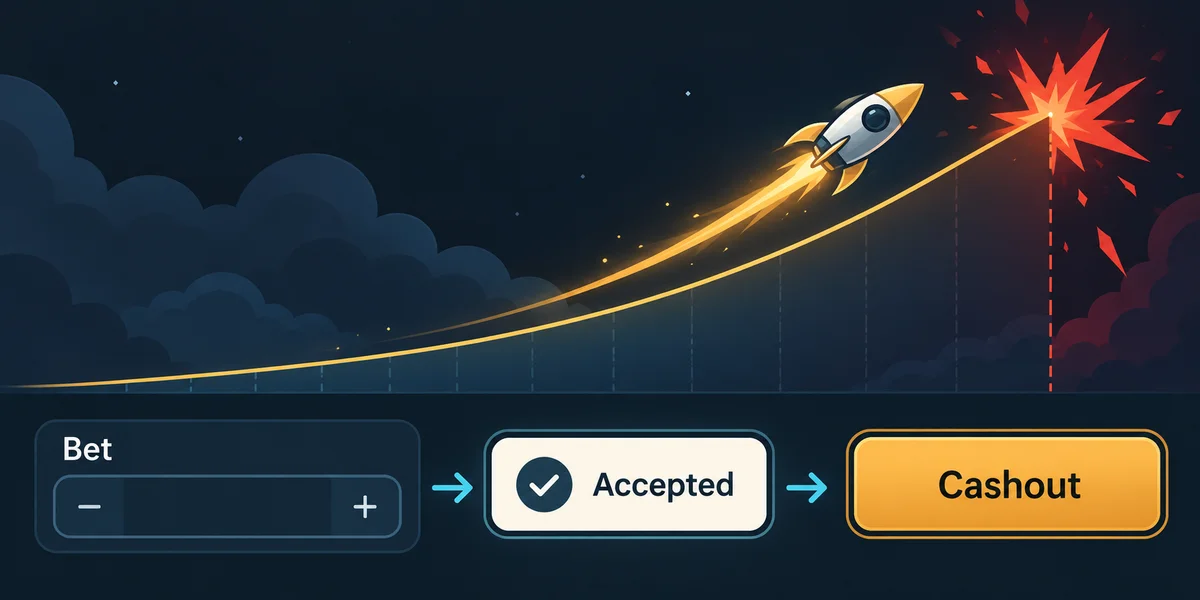


Lucky Jet uses a rising multiplier and a cashout decision. Before taking part, distinguish an amount entered in a panel from a bet accepted for a particular round. A result shown in the history belongs to a completed flight. A cashout request belongs to your accepted stake and needs its own confirmation. Learning those distinctions is more useful than treating the animation as a forecast or assuming that a fast click guarantees payment.
Read the controls in the version actually open
Look for the current multiplier, betting window, stake input, available balance, round history and individual bet history. Their position, labels, colours and limits can vary with the client, device and account. The guide describes their roles rather than certifying one universal screenshot. The provider's current rules and the cashier's currency determine applicable minimums and maximums; a dollar example here does not establish a ruble or real equivalent.
The multiplier history groups completed results for convenient reading. If the client marks results below 2x with one colour and results at least 10x with another, that colour is still a display category. It is not an instruction to enter the next round. Nor do chat messages or a leaderboard prove that every visible account belongs to an independent human or that displayed winnings are net profits after all stakes.
Some interfaces expose separate stake panels. Separate controls do not create independent flights: two accepted stakes in one round share its crash point. Check each panel's amount, target and automatic participation setting. A setting retained from a previous session can create different exposure from the amount you intended to place once. Do not count a pending win as settled available money.
A practical first-use sequence
- Open the game through the account's own catalogue and read its current rules. Check the account currency and permitted access conditions.
- Find the stake input and the displayed limits. Choose an amount from an existing affordable budget, including the sum of both panels if used.
- If choosing auto-cashout, enter the target and confirm the client accepted it. If choosing manual cashout, understand the actual request and settlement rule.
- During the displayed betting window, submit only the intended stake. Check the accepted round and amount instead of repeatedly clicking when confirmation is slow.
- After settlement, reconcile the individual bet record and balance. Stop new exposure if the record or pending instructions are unclear.
For a purely illustrative accepted stake of 0.50 at 1.50x, success pays 0.75 gross and earns 0.25 net. Failure loses 0.50. These numbers do not guarantee the minimum stake, target availability, speed or settlement behaviour of a particular account. The multiplier must satisfy the actual success condition. An animation approaching a target is not a confirmed payout.
Observation or a demo, when available, can help locate controls without placing a real stake. Neither is a mandatory step before registration. A demo balance is virtual, and matching graphics do not establish identical payout parameters or account conditions. You can also decide not to place a wager after reading the rules. There is no required five-round trial, deposit or installation in this guide.
Fixed stakes and current-balance fractions differ
Starting with 50 and losing three fixed stakes of 10 leaves 20, a 60% loss of the initial amount. Losing 20% of the current balance three times instead leaves 25.60, a 48.8% loss before rounding or minimum-stake rules. Calling both methods simply “20% stakes” hides a material difference. The following table uses only those declared assumptions.
| Stake rule | Start | After three losses | Loss from start |
|---|---|---|---|
| Fixed 10 | 50 | 20 | 60% |
| Current 20% | 50 | 25.60 | 48.8% |
With five fixed units available, three one-unit losses leave two units, not ruin. With three initial units the same three losses leave zero. A current-fraction rule may leave a positive balance that cannot fund the next minimum stake. Define the event and horizon before attaching a probability. The amount remaining is an arithmetic fact; its chance requires a separate outcome model.
For illustration only, use independent rounds with P(M≥k)=0.97/k, equality successful. Then a loss at target 1.5 has probability 53/150, and three specified losses have probability 4.411170%. That equals funding failure by three rounds for an initial three fixed units, but failure by three is zero for five initial units. Five specified losses have probability 0.550710%. These are not verified Lucky Jet measurements or probabilities for an unspecified session.
One hundred fixed units do not immunise a bankroll. Even the particular path of one hundred losses has positive probability in this model. More generally, accepted stake minimums, caps, simultaneous bets and chosen stopping rules matter. Size a stake from money already set aside; do not increase a deposit merely to satisfy a one-hundred-unit slogan. If the minimum does not fit, the next bet can be omitted.
Two panels share both the flight and the early loss
Consider two units targeted at 1.5x and one unit targeted at 3x in the same flight. Total entry cost is three units. If both instructions are accepted and settle as defined, the first successful stake pays three gross. That covers the combined entry cost only after the first target succeeds. Before that event, an early crash loses both stakes.
| Shared flight | Gross total | Combined net |
|---|---|---|
| M < 1.5 | 0 | -3 |
| 1.5 ≤ M < 3 | 3 | 0 |
| M ≥ 3 | 6 | 3 |
Under the illustrative reciprocal 3% model, the three probabilities are 35.333333%, 32.333333% and 32.333333%. The combined expected net is minus 0.09 per three units staked. The middle outcome breaks even, and the final outcome earns three net, not six. Conditional coverage is a payment identity, not an unconditional free bet or a positive-expectation system. Different target or stake ratios need their own ledger.
Two equal stakes at the same target behave like one stake of their total amount when they share settlement. They do not diversify the crash outcome. The more detailed dual-bet guide addresses the strategy separately; the immediate beginner check is simply whether both amounts and all automatic instructions match the intended total exposure.
Automation changes an instruction, not the outcome law
Auto-cashout can remove the need to send a manual click at the chosen target after its instruction is accepted. That does not establish zero network delay, universal millisecond execution or immunity to interruptions. The effect of a late manual request also depends on whether the actual arrival multiplier or a fixed intended multiplier is paid. The execution comparison explains why those rules cannot be merged.
Auto-bet is a different control: it can create repeated future stakes. Before using it, check the number of participations, each amount, each target and any actual stop settings. Auto-cashout on one panel does not impose a limit on whole-session losses. Closing a tab does not prove all accepted or scheduled instructions were cancelled. Confirm the relevant state in the real interface before considering exposure finished.
Check mistakes without inventing player research
There is no identified session study here establishing that five mistakes cause 90% of account losses. The useful checks are concrete: gross versus net payment, fixed versus changing stakes, one versus two accepted panels, a requested versus confirmed action, and completed history versus a future probability. These distinctions can be checked in the rules and records without assigning an unsupported percentage to other players.
Doubling after a loss increases the next required stake and can reach a balance or table cap. A sequence of past low results does not make a high result due under independence. Repeated turnover with negative conditional expectation does not become investing through better record keeping. A profit stop can preserve an already realised result after pending exposure ends; it does not guarantee the next session will profit.
Keep a chosen spending limit and ending time separate from a claim of safety. Record starting and ending balance, deposits, withdrawals and unsettled bets. Use the session exit guide to calculate a net result that includes transfers. Registration and partner links remain available directly. No calculator, demo or second deposit is a prerequisite, and no example here establishes a universal winning strategy.