
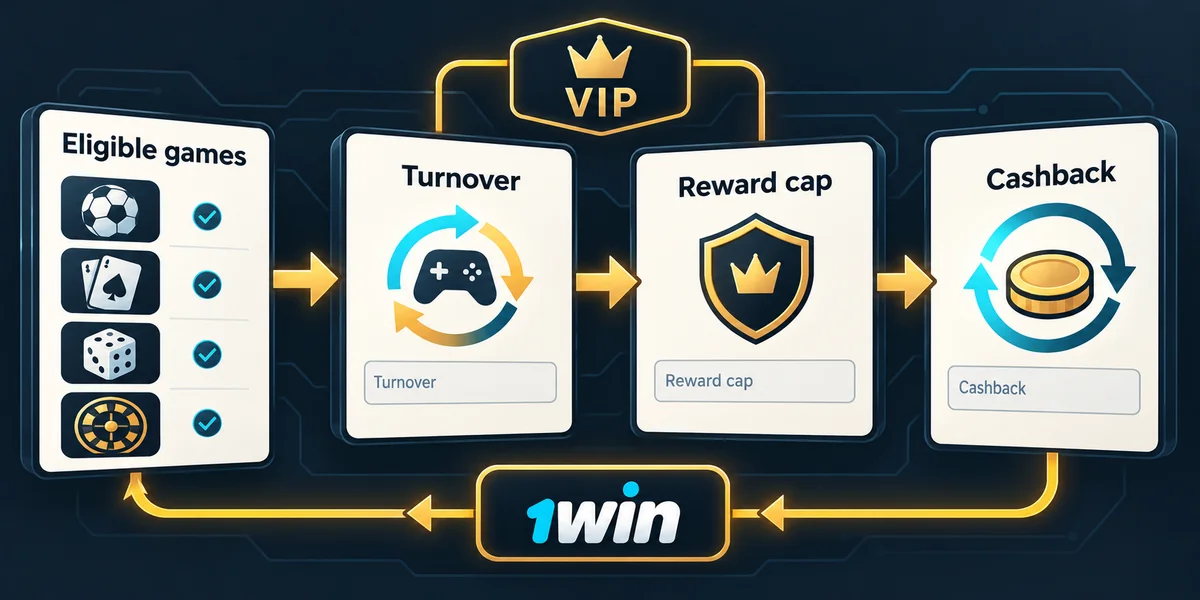


Cashback can add a benefit to eligible play when the credited amount and its conditions are clear. To evaluate it, identify the qualifying games, loss definition, calculation window, rate, cap and available promotional reserve. A high advertised rate alone cannot supply that calculation. Keep the reward separate from the game's own payout and from any welcome bonus whose release follows a different rule.
The advertised benefit has a defined scope
Checked on 23 October 2026, an administrator announcement on 1win's forum, dated 9 February 2025, advertises up to 30% weekly cashback on real-balance slot losses without wagering. That is useful first-party advertising evidence. It is not an identified current contract for every country, account or crash game.
In particular, do not silently extend “slots” to Lucky Jet. The announcement does not establish this account's tier thresholds, monetary cap, Saturday midnight credit, coin exchange rate or automatic stacking with a welcome bonus. Its reference to slot bets also does not fully specify how net losses and excluded stakes are reconciled. Read the actual selected offer before estimating a payment.
Define the base and the period first
For a hypothetical net-loss rule, let T be eligible stakes and W be gross eligible payouts over one window. Game net X equals W minus T. The eligible loss base is max(-X, 0), which is zero when the window finishes ahead. It is not the sum of every losing stake if winning payouts also count in the window.
A possible capped credit is A = min(B, C, r × max(-X, 0)), with reserve B, window cap C and rate r. Some actual cashback schemes may use another definition or have no promotional reserve; then do not insert an invented B restriction. This formula is a declared worksheet, not a verified description of 1win's complete current offer.
| Input | Meaning in this hypothetical model |
|---|---|
| T / W | Eligible stakes / gross game payouts |
| X = W - T | Net game result of the same window |
| r | Rate applied to positive net loss |
| B / C | Remaining reserve / window cap |
| A | Credit after settlement, external to game payout |
Specify the window's dates and timezone, eligible games, cash versus bonus play, returned or cancelled stakes and whether an earlier reward changes the next window's base. A weekly label does not identify a rolling versus calendar week. Nor does it prove payment at a particular hour. The base and period must match the actual statement before rates can be compared meaningfully.
Expected rebate needs the distribution of loss
For random results, expected credit is E[A]. In general it is not r times the positive part of minus E[X]. Taking a positive part and imposing caps do not commute with averaging. A winning window gets zero in the model, while losses in another window can still earn a credit. The following small example makes that difference reproducible without pretending to measure casino customers.
Assume independent accepted 2x bets with win probability 0.485, fixed stake one, no fees, no deposits, no early profit or loss stop, and one or two rounds. Initial cash equals the round count, so every requested stake is funded even on the all-loss path. Credit is paid only after the final settlement, at rate 20%, with reserve 100 and cap 100. None of these parameters is a claimed real promotion.
| Funded rounds | E[game net] | E[loss base] | E[rebate] | E[combined net] | Cash return incl. reward |
|---|---|---|---|---|---|
| 1 | -0.030000 | 0.515000 | 0.103000 | 0.073000 | 107.3000% |
| 2 | -0.060000 | 0.530450 | 0.106090 | 0.046090 | 102.3045% |
For one round, a loss has probability 0.515. Expected rebate is 0.20 × 0.515 = 0.103, not 0.006 obtained by multiplying 20% by the mean game loss of 0.03. Expected combined net is plus 0.073 in this artificial rule. Calling every possible loss rebate incapable of positive expectation would therefore also be incorrect. This result does not establish that the hypothetical offer exists or is eligible.
For two rounds in one window, only two losses create negative net: net minus two with probability 0.265225. The expected loss base is 0.53045, expected rebate 0.10609 and combined expected net plus 0.04609. Twenty percent of mean game loss 0.06 is only 0.012. Changing the aggregation window changes the calculation, so do not replace a weekly scheme with separate per-bet credits.
The table's return ratio includes the external hypothetical reward and divides expected total cash returned by fixed turnover. It is not a new game RTP, an observed player return or a guarantee of profit. With random turnover, even the choice of averaging a ratio or taking a ratio of expectations needs to be stated. Here turnover is fixed specifically to avoid that ambiguity.
Caps and exhaustion change the result
If net loss is 100, rate 20%, reserve 500 and cap 100, the rule pays 20. With only 12 of reserve left, it pays 12. With cap 5 it pays 5. With zero reserve or a positive-net window it pays zero. After the reserve of 12 is fully released, the next equally losing window receives nothing under the same reserve rule. These are different cases, not interchangeable “up to” payments.
A separate upper-bound example uses fixed eligible turnover of 250000, base expected game return 97% and an external payment capped at 750. Even if the cap were always fully paid, expected combined return could be no more than 97% + 750/250000 = 97.3%. It cannot reach 97.9% under those assumptions. The figures are illustrative, not verified current 1win thresholds or caps.
The familiar calculation 3% × (1-r) describes a deterministic 3% loss refunded at rate r without caps or insufficient reserve. At 20% it gives cost 2.4%; at 30%, 2.1%. It is not the general expectation for a random net-loss window. Choose the correct formula rather than presenting 20% and 30% as the same effective edge or quoting a universal RTP uplift.
Reproduce the declared example
Save promotion_models.py beside the block below. Exact fractions and explicit binomial probabilities calculate the fixed funded windows. An independent exhaustive check enumerated every outcome path for six short horizons under four cap/reserve settings. The code performs no account action and has no live promotion data. It supports the worksheet's arithmetic only.
from fractions import Fraction
import json
import logging
from promotion_models import toy_period

results = [{key: float(value) for key, value in toy_period(n).items()}
           for n in [1, 2]]
cap_bound = Fraction(97,100) + Fraction(750,250000)
assert cap_bound == Fraction(973,1000)
logging.basicConfig(level=logging.INFO, format="%(message)s")
logging.info(json.dumps({"windows": results, "capBound": float(cap_bound)}))
Coins and VIP services need their own offer
A loyalty point, a promotional wallet and a transferable crypto token are not automatically the same thing. If the account offers a named points balance, record how it is earned, its exchange value, minimum conversion, expiry, permitted uses and withdrawal restrictions. This guide has not verified a universal 1000-points-to-cash table, awards on every Lucky Jet bet or immediate unrestricted cash conversion.
Likewise, check any actual VIP invitation and written service terms. A personal manager or priority support, when offered, does not by itself establish a five-minute payout or a daily limit of 100000. Those specific limits are not confirmed here. Compare a benefit you would actually use with any additional requirements, rather than increasing turnover merely to obtain a higher label.
Check and record a reward in the account
- Open the account's actual reward or promotion section and identify the offer and applicable version.
- Confirm eligible games, period, calculation base, rate, cap and available balance where relevant.
- Check whether a claim action is required and when credit is scheduled. Do not assume an automatic Saturday payment.
- After credit, compare the reward statement with the cash and bonus balances. Keep game payouts and promotional transfers as separate entries.
- Before withdrawing, read the reward's actual conditions and pending account checks.
The welcome-bonus guide treats deposit stages and reserve release separately. The withdrawal guide distinguishes available cash and pending requests. Neither an advertised no-wagering benefit nor a separate balance display certifies instant payment in every account or market. There is no worldwide deposit-playthrough mandate stated here.
Use a reward as an additional benefit only after its conditions are clear. Registration remains directly accessible, and declining a bonus or stopping before a higher tier is allowed. No demo, calculator, new deposit or extra wagering is required by this article. An accurately recorded credit can improve that completed window's result; it does not insure future stakes or justify exceeding the spending amount chosen beforehand.