
SPRIBE publishes a 97% return-to-player figure for Aviator. That statement, a reproducible seed calculation and a study of real play are three different kinds of evidence. This article explains the SHA-512 calculation used by CrashMath and the mathematics of its declared reference model. We do not report a captured sample of 10,000 production rounds or a verified customer payout. The public synthetic CSV elsewhere on this site cannot establish those claims.
1. What the primary documentation establishes
The Aviator product page lists RTP as 97%. The provider's provably fair explanation describes combining server and player seeds with SHA-512, a SHA-256 commitment for the next server seed and game-specific conversion. These statements support a provider specification. They do not constitute our independent measurement of a selected operator's runtime, payout limits or settlement.
For a particular round, preserve the version, round identifier, revealed seed fields and the displayed result. If checking a prior commitment, preserve that value before betting with evidence linking it to the same round. A value copied only after play cannot establish when it first appeared. Supplier documentation, installed rules and actual recorded inputs have distinct roles; a familiar game name does not replace them.
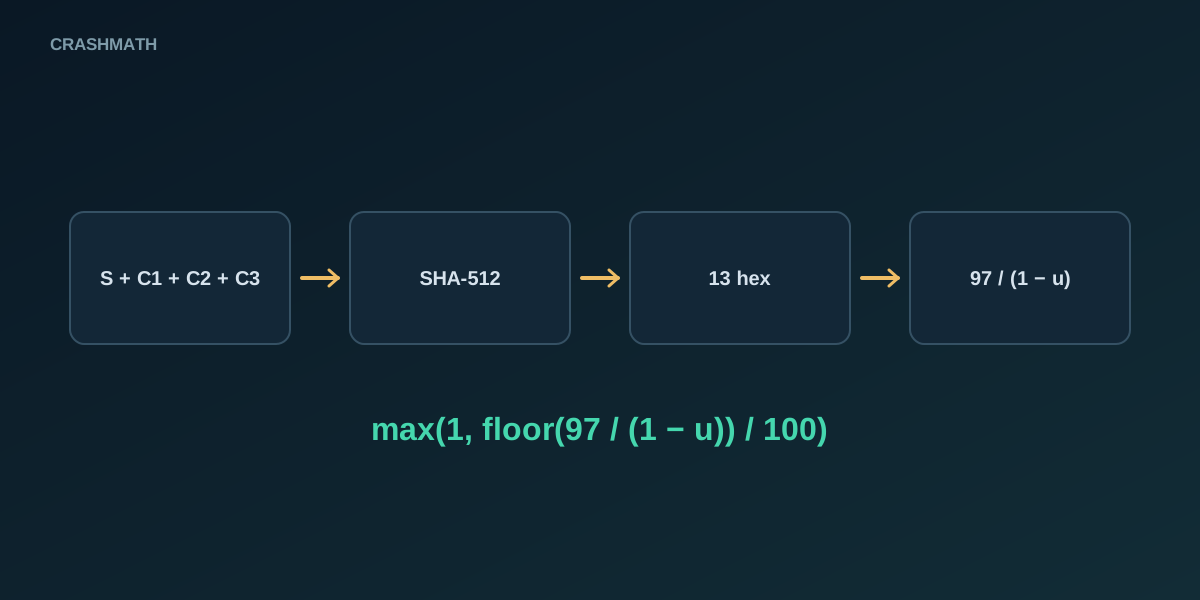
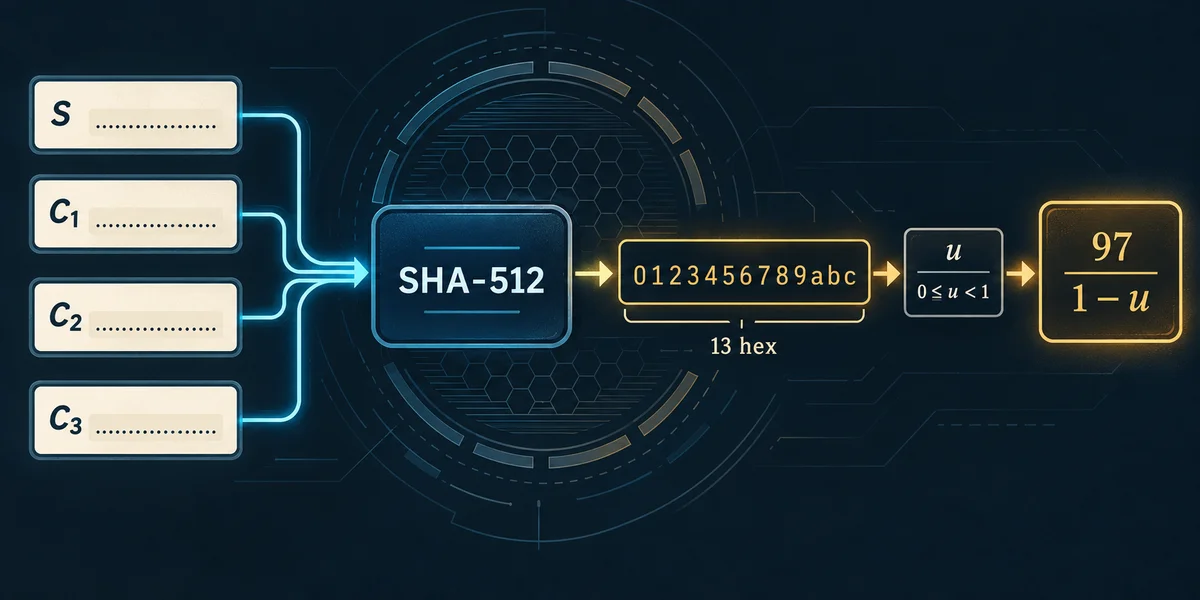
CrashMath's accepted Aviator branch takes one server string and three client strings in their recorded order. It concatenates them without separators, applies SHA-512 and maps the leading 13 hex characters as described below. It has no nonce, HMAC or modulo-33 condition. This existing calculation remains intact. The broad provider page is not presented as a complete publication of every implementation detail of this mapping.
| Evidence | Established here | Limit |
|---|---|---|
| Provider page | Published 97% RTP | Not a runtime measurement |
| Synthetic fixture | SHA-512 calculation 4.62x | Not a captured paid round |
| Declared distribution | Model probabilities | Not operator certification |
2. Follow the four-seed calculation
Let S be the server string and C1, C2, C3 the three client strings supplied for the calculation. Build S+C1+C2+C3 as literal UTF-8 text, then calculate its SHA-512 digest. The hexadecimal representation contains 128 characters. Input order, spacing and character encoding matter. Adding colons or appending a counter would produce a different message and is not part of this branch.
Interpret the first 13 hexadecimal characters as integer I. Since 13 hex characters represent 52 bits, set N=2^52=4,503,599,627,370,496 and u=I/N. The possible values form a finite grid from zero up to, but not including, one. The reference mapping is M=max(1, floor(97/(1-u))/100). This is equivalent to max(1, floor(100*0.97/(1-u))/100). The lower bound prevents displayed values below 1.00x.
The code examples use the same floating-point steps as the browser implementation. Integer counting below is a separate mathematical reference for an ideal uniform 52-bit grid; it does not assert perfect numerical behaviour at every extreme input or establish uniformity of real seeds. A claim of exact production reproduction needs actual round records, not only an equation. The complete test strings are public synthetic data.
3. Reproduce the browser's synthetic control
The preset uses server string crashmath_demo01 and client strings aviator_client_1, aviator_client_2 and aviator_client_3. Their concatenation produces the following digest and calculated 4.62x result. The seed hash shown alongside it is calculable from public data; its presence does not prove a real prior commitment. No observed casino round or transfer is attached to this fixture.
{
  "serverSeed": "crashmath_demo01",
  "clientSeeds": [
    "aviator_client_1",
    "aviator_client_2",
    "aviator_client_3"
  ],
  "status": "calculated",
  "sha256Seed": "4adff76b97aa5a82f8f02f7186b62365aea6de5db0ce9620bdf20430998cf598",
  "sha512": "ca4b98c1489a9a2675685955d0632dddcb265344f3eb0cd60316e20a1674ba936442d2a626290347c5e713cd6b458dde83a681265037bd781b857903083e4996",
  "integer": 3558816546589097,
  "u": 0.7902160140880403,
  "multiplier": 4.62
}
The browser hash walkthrough includes that Aviator preset. It reports calculated and asks the reader to compare with an independent record. It does not accept separate expected commitment and recorded-multiplier fields for automatic matching. Do not describe pressing the preset button as verification of live gameplay. Its neighbouring HMAC modes are illustrative models with different rules.
Python calculation
import hashlib
import json
import logging
import math

def calculate_aviator(server_seed, client_1, client_2, client_3):
    seeds = [server_seed, client_1, client_2, client_3]
    if not all(isinstance(seed, str) and seed for seed in seeds):
        raise ValueError("Four nonempty seed strings required")
    combined = "".join(seeds)
    digest = hashlib.sha512(combined.encode("utf-8")).hexdigest()
    integer = int(digest[:13], 16)
    u = integer / (2 ** 52)
    multiplier = max(1.0, math.floor((0.97 / (1.0 - u)) * 100) / 100)
    return {"status": "calculated", "sha512": digest, "multiplier": multiplier}

logging.basicConfig(level=logging.INFO, format="%(message)s")
logging.info(json.dumps(calculate_aviator(
    "crashmath_demo01", "aviator_client_1", "aviator_client_2", "aviator_client_3"
)))
JavaScript with Web Crypto
async function calculateAviator(serverSeed, c1, c2, c3) {
  const seeds = [serverSeed, c1, c2, c3];
  if (seeds.some(seed => typeof seed !== 'string' || !seed)) {
    throw new TypeError('Four nonempty seed strings required');
  }
  const combined = seeds.join('');
  const bytes = await crypto.subtle.digest('SHA-512', new TextEncoder().encode(combined));
  const hash = Array.from(new Uint8Array(bytes), b => b.toString(16).padStart(2, '0')).join('');
  const integer = parseInt(hash.slice(0, 13), 16);
  const u = integer / 2 ** 52;
  const multiplier = Math.max(1, Math.floor((0.97 / (1 - u)) * 100) / 100);
  return {status:'calculated', sha512:hash, multiplier};
}
console.log(JSON.stringify(await calculateAviator(
  'crashmath_demo01', 'aviator_client_1', 'aviator_client_2', 'aviator_client_3'
)));
The browser trims outer seed whitespace before calculating. These standalone functions use the strings passed to them unchanged. Preserve the original record and establish the intended encoding rather than treating any normalisation as universally correct.
Both functions return a calculation. If a supplied seed belongs to an active undisclosed state, do not share it with an unfamiliar service. For learning, the public strings above are sufficient. For a real historical comparison, preserve the exact record rather than replacing inputs until a desired result appears. A transcription or version error can explain an initial mismatch and needs investigation.
4. Derive return under the stated model
For the ideal continuous approximation, take u uniform in [0,1). Before flooring, the reciprocal value is X=0.97/(1-u). A target k above 1 is reached when u is at least 1-0.97/k. On a cent-aligned target grid, flooring does not change that threshold in the continuous model. Consequently P(M>=k)=0.97/k, expected gross payout per unit is k times that probability, and expected net result is -0.03 before other costs.
| Target | Ideal hit probability | Expected net per unit |
|---|---|---|
| 1.50x | 64.6667% | -0.03 |
| 2.00x | 48.5000% | -0.03 |
| 5.00x | 19.4000% | -0.03 |
| 10.00x | 9.7000% | -0.03 |
| 100.00x | 0.9700% | -0.03 |
These are model probabilities, not measured success rates from our own live sample. With a finite digest grid, exact counts differ slightly from the continuous expression. A target with precision unsupported by the game, a payout cap or a different settlement boundary also needs its own rule. A payout amount including the returned stake must not be confused with net profit. The model does not say every session returns exactly 97%.
At a fixed funded stake of 10 units, the expected cost per model wager is 0.30 units. One thousand fully funded wagers therefore have expected net -300 before extra costs. That statement requires the turnover to occur. A balance that runs out earlier cannot continue funding the next stake in a valid ledger. The EV calculator examines chosen assumptions, not an independently discovered real return.
5. Why displayed 1.00x is not a 3% atom
Clamping and flooring produce displayed 1.00x whenever the unrounded reciprocal value is below 1.01. Solving 0.97/(1-u)<1.01 gives u<4/101. In the continuous approximation the mass is therefore about 3.960396%, rather than exactly 3%. On the uniform 52-bit grid, the count is ceil(4N/101)=178,360,381,282,000. This combines values below one with those that floor to one.
This boundary calculation describes the reference distribution. It is not a measured instant-crash rate at an operator. A displayed 1x also does not independently define whether a wager targeting exactly 1x can settle; that requires the actual game's rules. Do not add another instant-bust filter merely to force the displayed frequency to look like the edge parameter. That changes the mathematical model.
6. An extra modulo filter changes the return
Consider a hypothetical variant that first forces 1.00x whenever I is divisible by 33 and otherwise applies the same 0.97 mapping. This is not a finding about a named clone or a claim that we surveyed repositories. At target 2x, the base uniform grid has 2,184,245,819,274,690 winning integers. The extra condition removes 66,189,267,250,749 of them. Exact counting gives the returns below without assuming independence between the filter and threshold.
| Uniform-grid variant | Winning integers at 2x | Gross return per unit |
|---|---|---|
| Base mapping | 2184245819274690 | 0.970000000000 |
| With additional modulo-33 | 2118056552023941 | 0.940606060606 |
The approximate combined gross return is 0.940606, not 0.97. Multiplying 0.97 by 32/33 is a useful approximation here; the finite-grid count makes the scope precise. This demonstrates why combining two independent-looking margin mechanisms is not harmless. It does not establish that every non-Aviator game uses this variant or that an unfamiliar protocol is fraudulent. Match the implementation to its own published specification.
7. Leave missing implementation facts unresolved
The retrieved provider explanation does not establish what a particular installation does when fewer than three relevant player inputs are available. We do not fill that gap with invented default or historical seeds. If the selected round cannot provide the inputs required by this calculation, leave the reproduction incomplete and seek the version's exact rules. A busy lobby is not proof that every seed came from an independent human.
A commitment check and a result check also do not prove uniform seed generation, absence of preselection, complete history, payment reliability or legal eligibility. Client contribution helps under specified timing and unpredictability conditions. Calling a design multi-party does not independently establish those conditions. The general verification guide separates these questions and explains why a matching digest has bounded meaning.
8. What a genuine production study would need
A reproducible study needs an identified operator and version, capture dates, round identifiers, commitments with timing, revealed seeds, conversion code and a complete inclusion rule. A measured wager return also needs accepted stakes, targets, payouts and funding; the mean crash multiplier is not a bettor's RTP. Claiming an actual paid maximum requires settlement evidence beyond a large number in a history panel.
No such 10,000-round packet is published with this article. Our synthetic CSV analysis uses another HMAC generator and has no timestamps. It cannot serve as a captured Aviator study. A goodness-of-fit test that fails to reject a model would not prove unmanipulated production anyway. Therefore no fabricated chi-square, confidence interval or paid-record statistic appears as a result here.
The practical outcome is a reproducible SHA-512 control and explicitly scoped mathematics. Direct partner actions remain separate from the calculation and require no verification exercise. Neither the published RTP nor a successful synthetic example is a guarantee of profit, a certification of an operator or a reason to increase a stake.